Culture
Why Robots Still Can't Open a Drawer
Eva Lee
6
mins
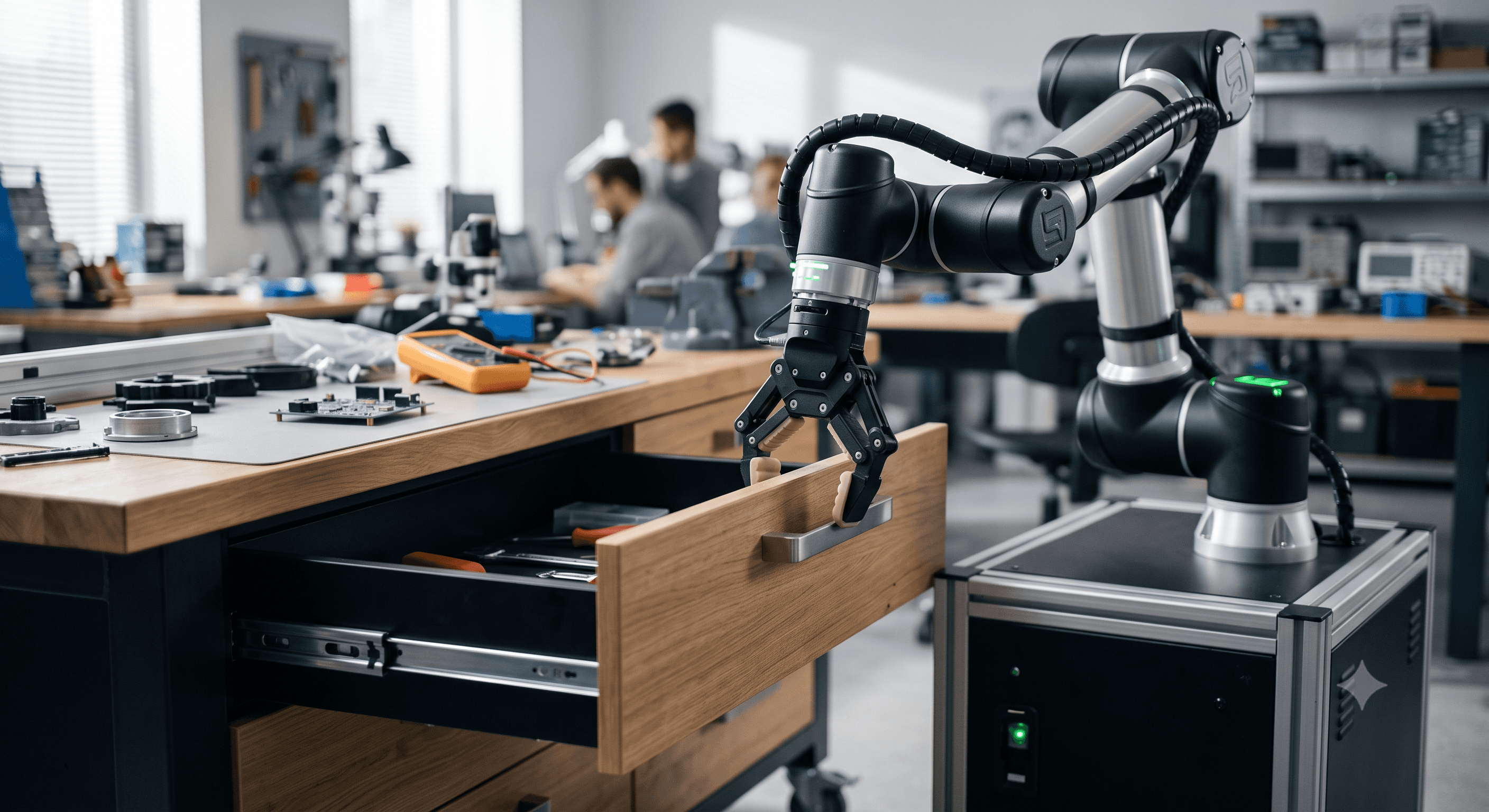
A robot that can lift a 40kg pallet still struggles with a drawer
Ask a warehouse robotics team what their hardest task is, and it's rarely the heavy lifting. It's the small, ordinary stuff. Opening a drawer. Picking up a loose cable. Turning a door handle that's slightly stuck.
These tasks look simple because we do them without thinking. For a robot, they're some of the hardest problems in the field.
The usual explanation is that the AI model isn't good enough yet. Give it more data, more compute, a bigger model, and it'll get there.
We at N.dot.light think that explanation is only half right. The model matters. But most robots never see the physical world clearly enough to learn from it in the first place. The bottleneck is upstream, in the environment the robot trains on before it ever touches a real drawer.
"Pretty 3D" and "simulation-ready 3D" are not the same thing
A 3D model that looks correct on screen and a 3D model a robot can actually learn from are two very different objects.
A model built for a game or a product render only needs to look right from the outside. It needs a clean surface and good lighting. Nobody checks whether the hinge moves the way a real hinge moves.
A model built for robot training has to behave right, not just look right. It needs a collision mesh, the invisible geometry that tells a physics engine where one solid object ends and empty space begins. It needs joint structure, so the robot's simulator knows the handle rotates on an axis instead of floating free. It needs physical properties like mass, friction, and material stiffness, so a virtual push produces the same kind of resistance a real push would.
Miss any one of these, and the robot learns something. It just learns something wrong. This is where the sim-to-real gap actually comes from. Not from the renderer. From physics that was never modeled in the first place.
Three things a training-ready 3D asset needs that a "pretty" one doesn't:
A collision mesh that matches the real geometry, not a rough approximation
Joint and articulation data, so moving parts move the way they're supposed to
Physical properties like mass and friction, tuned to real-world material behavior
Why this is a data infrastructure problem, not a modeling problem
As physical AI scales, the constraint shifts. It's no longer "can we train a bigger model." It's "do we have enough physically accurate environments to train it in."
Today, most of that environment data is built by hand. An artist or engineer manually rigs collision meshes and joints, asset by asset. That doesn't scale to the tens of thousands of object variations a general-purpose robot needs to see.
We at N.dot.light built TRINIX around a simple bet. If CAD is where physical objects already live in digital form, then CAD is the right starting point for simulation data, not a game engine and not a generative image model. Our engine takes existing CAD and generative 3D and turns it into simulation-ready assets automatically, with collision geometry, joints, and physical properties generated as part of the pipeline instead of added by hand afterward.
What this means going forward
The next generation of physical AI won't be limited by how clever the model is. It'll be limited by how much of the physical world it's actually seen in a form it can learn from.
We think the teams that solve the environment problem first will be the ones whose robots open the drawer on the first try, and the tenth, and the thousandth.
Latest Content

Culture
[Role Interview] "Opportunity Regardless of Tenure" with Graphics Engineer Siyoung
[Role Interview] "Opportunity Regardless of Tenure" with Graphics Engineer Siyoung
Eva Lee
6
mins

Insights
Reviving Legacy CAD Data for a World That Trains Robots
Reviving Legacy CAD Data for a World That Trains Robots
Eva Lee
7
mins

